Upskilling With Social Media: Accelerate Your Career via Short-Form Learning
Discover how short-form content on social media can fast-track your upskilling journey and improve your career prospects.
.png)
.avif)
Think your current skill set will carry you through the next five years? Think again. According to the World Economic Forum, employers expect 39% of workers’ core skills to change by 2030. That means nearly half of what you know today may need updating sooner than you think.
Traditional development programs are valuable, but they often can’t keep pace with rapid shifts in technology, roles, and industry demands. That’s where short-form learning comes in.
Social media has become a surprisingly effective channel for career development. You can explore new technologies or brush up on soft skills on platforms like TikTok, Instagram, and LinkedIn, which offer a steady stream of relevant, accessible content. It’s skill development on your terms, fitting into your routine, matching your pace, and aligning with your professional goals.
Why upskilling matters more than ever in 2025
Standing still means falling behind in today's job market. The pressure to level up is real, with influences from automation, AI disruption, and industry-wide digital transformation rapidly changing the nature of work. Businesses are scrambling to fill emerging roles, and changing job requirements mean most professionals will need to refresh or expand their skill sets to stay relevant.
One major challenge is the tight labor market, which is making it harder for companies to close skill gaps. As new roles emerge and current roles change, the demand for flexible, fast-paced reskilling and upskilling programs is growing. Professionals are no longer just climbing the ladder—they're adapting their career paths to meet the future of work.
Young workers know the value of this. That's why continuous learning isn’t just a job perk anymore—it’s an expectation. In fact, 61% of Gen Z freelancers say they freelance to gain greater control over their personal growth and career direction.
Upskilling helps professionals stay competitive in their current roles while preparing for new opportunities. For organizations, skill renewal is essential for employee retention and long-term success.
The rise of microlearning and short-form education
As demand for fast, flexible learning grows, microlearning has become a popular solution. Microlearning breaks down complex topics into small, digestible chunks—think two- to 10-minute videos, infographics, or short interactive lessons. These formats are tailored to fit modern attention spans and designed for maximum retention.
The microlearning market was valued at $2.6 billion in 2024 and is projected to reach $6.8 billion by 2033. That growth reflects a broader shift toward short-form learning experiences that fit seamlessly into busy schedules and support ongoing development at your own pace.
Social media has become a natural home for this trend. Platforms like TikTok, LinkedIn, YouTube, and Instagram offer microlearning opportunities that are engaging, mobile-friendly, and easy to access.
The benefits of upskilling via social media include:
- Better learner engagement. Short, interactive content keeps attention high and makes learning feel more enjoyable and accessible.
- Increased information retention. Bite-sized lessons are easier to digest and recall, especially when paired with repetition and visual cues.
More consistent exposure to new skills. Social feeds provide ongoing access to fresh insights, helping professionals stay current without formal coursework.
All this comes without the need to carve out hours of uninterrupted time. It’s short-form learning built for the future of work.
Microlearning vs. traditional learning: when to choose each
For professionals juggling busy schedules, not all learning formats deliver equal value. Microlearning offers a faster, more flexible alternative to traditional training programs. Designed around short-form learning modules, this method supports continuous professional development at your own pace.
The effectiveness of microlearning versus traditional learning depends on your goals, schedule, and learning environment:
Microlearning is ideal for reinforcing knowledge, boosting retention, or quickly acquiring a specific skill, especially when time is limited. It works well for just-in-time learning or when you need to fit development into short breaks. It’s easier to complete and keeps learners engaged with its bite-sized format. However, it may lack the depth or comprehensive frameworks found in longer training.
Traditional courses offer deeper, more structured learning, which can be important for mastering complex topics or earning certifications. It shines in scenarios where depth, mentorship, and cumulative understanding are key. While completion takes longer, it offers more opportunities for interaction, reflection, and skill integration—especially in cohort-based settings.
While traditional courses can still be useful in long-term development plans, microlearning excels when the goal is rapid skill acquisition or improving retention rates. Here’s how the two approaches compare:

Microlearning aligns better for workers trying to level up without disrupting their day jobs and routines. It’s a format built for today’s professionals, whether you're developing a specific competency or following a broader development plan.
What makes microlearning content work is its simplicity. Creators break down complex subjects into quick, actionable lessons. This format makes learning more approachable and offers real mentoring value, especially for professionals without access to formal training programs.
Social media as a powerful learning ecosystem
Social media has become a hub for education and upskilling. Platforms like TikTok, LinkedIn, and Instagram are leading a digital transformation in how we approach career development. Through short-form learning content, professionals are turning scrolling time into growth time.
On TikTok, the tag #LearnOnTikTok has over 45 million posts, showcasing everything from coding tutorials to public speaking tips. LinkedIn offers bite-sized courses and industry updates directly from experts, while Instagram is home to creators who turn new technologies and soft skills into snackable content.
This new wave of social media education blends flexibility, relevance, and community, making it easier than ever to explore upskilling opportunities at your own pace.
For learners juggling jobs, family, or side hustles, social platforms offer a gateway to timely and accessible online courses and knowledge-sharing. Whether you're building technical fluency or just staying current on industry trends, short-form learning on social media meets you where you are and keeps you moving forward.
Educational niches thriving on social platforms
These are just a few of the countless educational creators and communities that are booming on social media:
- #fintok and #moneytok on TikTok offer accessible advice on budgeting, saving, and financial planning. These popular niches have racked up 16.3 billion views.
- #careertok on TikTok delivers guidance on resume writing, job interviews, and professional growth.
- #homeimprovement on TikTok features tips and tutorials on DIY projects, home repairs, and renovation ideas for both beginners and experienced builders.
- @coding.beast on Instagram provides practical insights for web developers, with posts covering JavaScript, React, CSS tips, coding interview prep, and advice for first-time coders—all organized in a feed that’s easy to navigate by topic.
- @andy_cooks on YouTube shares cooking content from a trained chef with global experience, offering approachable recipes and tips that make culinary skills more accessible.
- Ai Mindshare on LinkedIn is an active group focused on topics like artificial intelligence, machine learning, data science, generative AI, large language models, automation, and AI agents, making it a valuable space for professionals exploring emerging tech.
- Digital Marketing on LinkedIn is the largest community for marketers on the platform, featuring conversations, resources, and networking opportunities across SEO, content strategy, paid media, and analytics.
These examples are just a starting point. New voices and topics emerge in the world of short-form learning every day.
Depending on your goals, you might also explore microlearning niches like these. Consider these examples of how professionals in other roles can use each skill to advance or pivot their careers.
- User experience (UX)/user interface (UI) design. Learning UX/UI can help a graphic designer expand into digital product roles, creating opportunities to work on apps, websites, and user-focused platforms.
- Language learning. A customer service agent who becomes fluent in a second language can transition into bilingual support roles or global communications positions.
- Project management. A marketing coordinator can step into leadership roles by mastering project management, allowing them to oversee campaigns and cross-functional teams.
- Public speaking. An engineer who hones public speaking skills can take on conference presentations, expand client-facing roles, or move into team leadership more confidently.
Whatever skills you’re looking to build, there’s a social media creator—or an entire community—ready to help you grow.
How to start your upskilling journey on social media
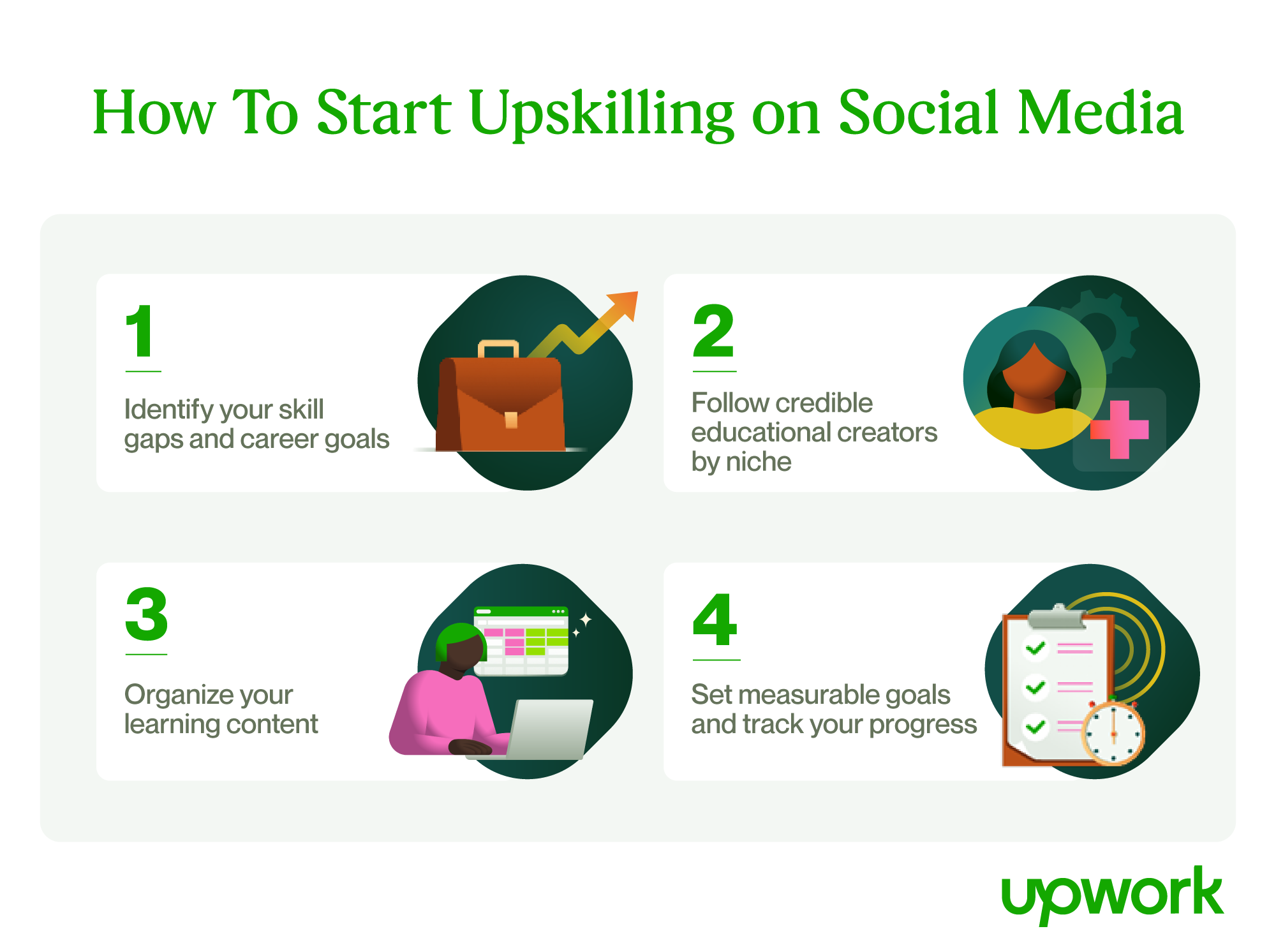
Ready to grow your skill set without enrolling in formal training programs? Social platforms offer a flexible, self-paced way to tap into continuous learning and uncover new growth opportunities. Whether you’re aiming to switch industries or strengthen your current role, a focused upskilling strategy can make your learning experiences more effective—and more rewarding.
Here are four simple steps to get started:
- Identify your skill gaps and career goals. Pinpoint what competencies you need for your next career move.
- Follow credible educational creators by niche. Use hashtags related to your area of interest, subscribe to YouTube channels, or follow LinkedIn educators who share industry-specific tips.
- Organize your learning content. Save videos and posts to topic-specific playlists or boards so you can easily revisit them as you build your development plan.
- Set measurable goals and track your progress. Use tools like spreadsheets, productivity apps, or learning trackers to stay accountable and see how your skill set evolves over time.
This intentional approach helps transform passive scrolling into purposeful mentoring and microlearning and keeps your upskilling journey aligned with your career goals.
How to overcome the challenges of social learning
Social media education offers powerful benefits—but it’s not without challenges. The same platforms that deliver bite-sized insights can also distract, overwhelm, or misinform learners. Without a clear plan, it’s easy to scroll aimlessly instead of actually learning.
To stay focused and get the most from short-form content, learners should be proactive about managing their digital environments.
Here are a few ways to overcome the most common pitfalls of social learning:
- Set time limits. Use app timers or browser extensions to control how much time you spend consuming learning content versus general scrolling.
- Curate your feed. Follow and engage with creators focused on things that align with the skills you want to hone. Look for creators with relevant experience, certifications, or professional credentials—especially when learning technical skills.
- Use playlists and folders. Save useful posts by category so you can return to them for deeper study or application.
- Supplement with structure. Pair your social media learning with more formal options like webinars, digital learning communities, or certification courses to reinforce credibility.
The business case for microlearning adoption
For organizations, upskilling employees through microlearning can be a high-ROI approach to training and development because it:
- Supports broader development efforts. When integrated into upskilling initiatives and development programs, microlearning can fuel employee growth and streamline onboarding for new talent.
- Aligns with modern expectations. Upskilling through microlearning contributes to meeting the needs of today’s workforce by helping build employees' skills so they can stay current.
In a job market shaped by digital transformation and rapid change, companies can’t afford to overlook microlearning’s potential. It’s a future-proof investment that benefits workers and the bottom line.
Take ownership of your career through social learning
Social platforms may be filled with memes and trends, but they’re also full of opportunity. Today’s professionals are using short-form content to gain new skills, expand their career growth potential, and build development plans tailored to their unique goals.
With the proven benefits of upskilling and the rise of microlearning, now is the time to reframe how you think about learning experiences. Whether you’re trying to break into a new field, sharpen your current skill set, or respond to shifts in the job market, social media education can help you stay ready—and stay relevant.
Ready to turn your new skills into real work opportunities? Browse jobs on Upwork or find top professionals to support your next project.

.avif)

Author Spotlight

Upwork is the world’s largest human and AI-powered work marketplace that connects businesses with independent talent from across the globe. We serve everyone from one-person startups to large organizations with a powerful, trust-driven platform that enables companies and talent to work together in new ways that unlock their potential.